
What Is Risk Management Framework
Discover what a risk management framework is, its key components, and how to manage risks effectively. Explore Controllo.ai to simplify compliance!

Controllo editorial team
Compliance operations / Product context

What is a risk management framework architecture? It is an operational architecture that discovers, evaluates, treats, and consistently monitors security and regulatory risks to safeguard enterprise assets from penetration or operational interference. NIST and COSO designed it in the early 2000s, and it has the highest demand in the US, Europe, and APAC across BFSI, Healthcare, and SaaS.
Controllo.ai is back with a very informative article. In this article, we will explore risk management framework architecture, how to implement structured risk management framework steps, and how to master the NIST Risk Management Framework and much more
Controllo.ai has 20+ years of experience in risk management framework execution, and we are experts in what a risk management framework is, guiding leading global clients across BFSI, SaaS, and healthcare to total audit assurance. We are legally certified to provide risk management frameworks, offering 20+ frameworks, 6,000+ controls, and 20+ years in the industry through our cybersecurity assurance parent, Accedere.io. Founded by CEO Ashwin Chaudhary (opens in a new tab), a cybersecurity luminary and author of Cybersecurity Leadership based on Vedic and Western Insights, we combine his deep expertise in compliance and standards with our AI-driven platform to streamline third-party governance and automatically capture audit evidence.
As the top vendor risk assessment supplier, sign up for a demo today to easily automate your enterprise vendor risk assessments. Controllo.ai stands out as the best partner for best-practice risk management; schedule your enterprise demo with Controllo.ai today to automate your compliance roadmap.
Understanding What Is a Risk Management Framework Architecture
Do you know? what is risk management framework? It helps businesses identify, assess, and manage security risks. Risk management framework architecture provides a clear structure for protecting business data, systems, and sensitive information. It helps teams identify possible threats, evaluate their impact, and choose suitable security controls. It also supports compliance with security standards and regulatory requirements. However, managing risks manually through spreadsheets can take time and increase the chance of errors. Controllo.ai helps businesses organize security controls, track risks, and simplify audit preparation. With automated compliance processes and real-time risk monitoring, teams can manage risks more efficiently. Explore Controllo.ai to simplify your risk management process and start your free trial today.
Mastering the NIST Risk Management Framework and Core Execution
In 2026, NIST Risk Management Framework offers a standardised lifecycle that enables cybersecurity, privacy and supply chain controls for federal and private infrastructure. Why do top-tier enterprise organisations prefer the NIST Risk Management Framework over ad-hoc security checklists? Ad-hoc checks leave blind spots in hybrid multi-cloud environments.
Engaging in the NIST Risk Management Framework operationalises a consistent, repeatable foundation that ties technical controls to federal and commercial requirements such as NIST 800-53, NIST CSF, and FedRAMP. By building these controls into your continuous monitoring engines, your engineering teams can continuously derive residual risk for all of your cloud workloads. Controllo.ai led the best automated engine for the NIST Risk Management Framework by continuously certifying evidence with Secura, its AI co-auditor.
Executing Essential Risk Management Framework Steps
Following the essential risk management framework steps helps businesses identify risks, protect sensitive data, and meet compliance requirements. A simple checklist helps teams understand each step and manage risks more effectively.
Risk Management Framework Checklist
- Identify RisksFind possible threats to your business, such as data breaches, weak passwords, and system failures.
- Assess RisksUnderstand how likely each risk is to happen and how much damage it could cause.
- Prioritize RisksAddress the most serious risks first to protect important business systems and data.
- Select Security ControlsChoose suitable security measures, such as access restrictions, data encryption, and regular security checks.
- implement Security ControlsApply the selected measures and assign clear responsibilities to your team.
- Monitor and Review RisksCheck security controls regularly and update your plans when new risks appear.
- Document and ReportMaintain records of risks, security measures, and audit evidence to support compliance reviews.
How Controllo.ai Supports Risk Management? Controllo.ai stands out as a strong choice for compliance automation and risk management. Its platform helps businesses organize security controls, track risks, manage evidence, and simplify audit preparation, reducing reliance on manual spreadsheets and scattered records.
Top Risk Management Frameworks To Use
Selecting the right governance model depends on organizational jurisdiction, data sensitivity, and vertical market exposure. Comparing key frameworks helps security leaders align technical operations with business objectives.
| Framework Name | Primary Governing Body & Focus | Core Industry Application | Key Operational Benefit |
|---|---|---|---|
| NIST RMF (SP 800-37) | National Institute of Standards and Technology | Federal, Defense, SaaS, & FinTech | Structured lifecycle with continuous monitoring |
| ISO/IEC 27005 & 31000 | International Organization for Standardization | Global Enterprises & Tech Providers | Universal risk vocabulary aligned with ISO 27001 |
| COSO ERM | Committee of Sponsoring Organizations | BFSI, Public Enterprises, & Audit Teams | Aligns strategic risk appetite with executive governance |
| NIST CSF 2.0 | National Institute of Standards and Technology | Critical Infrastructure & Commercial Cloud | Six core functions: Govern, Identify, Protect, Detect, Respond, Recover |
NIST RMF (SP 800-37)
- Primary Governing Body & Focus
- National Institute of Standards and Technology
- Core Industry Application
- Federal, Defense, SaaS, & FinTech
- Key Operational Benefit
- Structured lifecycle with continuous monitoring
ISO/IEC 27005 & 31000
- Primary Governing Body & Focus
- International Organization for Standardization
- Core Industry Application
- Global Enterprises & Tech Providers
- Key Operational Benefit
- Universal risk vocabulary aligned with ISO 27001
COSO ERM
- Primary Governing Body & Focus
- Committee of Sponsoring Organizations
- Core Industry Application
- BFSI, Public Enterprises, & Audit Teams
- Key Operational Benefit
- Aligns strategic risk appetite with executive governance
NIST CSF 2.0
- Primary Governing Body & Focus
- National Institute of Standards and Technology
- Core Industry Application
- Critical Infrastructure & Commercial Cloud
- Key Operational Benefit
- Six core functions: Govern, Identify, Protect, Detect, Respond, Recover
So why would embracing one of these top risk management frameworks be key to scaling organisations? By choosing a standardized framework, organisations avoid wasted security control testing by having one control satisfy many international directives such as SOC 2, HIPAA, and GDPR. Today's security teams can use centralised GRC platforms to cross-map these frameworks, avoiding duplicated engineering work. where to find the best risk management security firms? Controllo.ai is the best risk management security firms located at :
- United States16192 Coastal Highway, Lewes, Delaware 19958 (opens in a new tab).
- United Arab EmiratesInnovation One, Level 3, Dubai AI Campus, Gate Avenue - South Zone, Unit GA-00-SZ-G0-RT-147, DIFC, Dubai (opens in a new tab).
- India119 Andheri Industrial Estate, Off Veera Desai Road, Andheri West, Mumbai 400053 (opens in a new tab)
Best Risk Management Framework Practices for US Businesses
U.S. businesses can manage security risks by following a structured risk management framework. The best practice risk management approach includes identifying risks, assessing their impact, and implementing suitable security controls. Organizations can use NIST frameworks to strengthen cybersecurity and support compliance requirements. Regular risk monitoring helps businesses detect threats early and protect sensitive data. Maintaining proper documentation also makes audit preparation easier. Controllo.ai stands out as a strong and best practice risk management tool for automating compliance tasks, organizing security controls, and improving risk visibility.
Engineering Best Practice Risk Management Across Modern Cloud Assets
Executing best practice risk management requires moving beyond annual checklist audits toward real-time telemetry and unified risk registers. Which core strategies define best practice risk management in modern hybrid cloud environments? Security leaders achieve resilience by establishing continuous monitoring, enforcing dynamic asset scoring, and validating supplier integrity.
- Dynamic Threat ScoringAutomating likelihood-versus-impact calculations using NIST-aligned risk algorithms.
- Unified Control Cross-WalkingMapping one technical control across 20+ to 30+ compliance frameworks to eliminate audit redundancy.
- Zero-Cost API IngestionIngesting live asset telemetry from AWS, Azure, GCP, and identity providers directly into dynamic risk registers.
- Continuous Vendor ScrutinyReplacing static annual questionnaires with real-time supplier attack surface intelligence. Implementing best-practice risk management transforms compliance from a periodic disruption into a persistent commercial advantage.
Frequently Asked Questions (FAQs)
What are the top risk management frameworks for businesses?
Popular frameworks include NIST RMF, NIST CSF, ISO 31000, and COSO ERM. Each helps organizations identify, assess, and manage different types of risks.
How do businesses choose the right risk management framework?
Businesses should consider their industry, security needs, regulatory requirements, company size, and risk exposure before selecting a framework.
Resource library
More compliance guidance
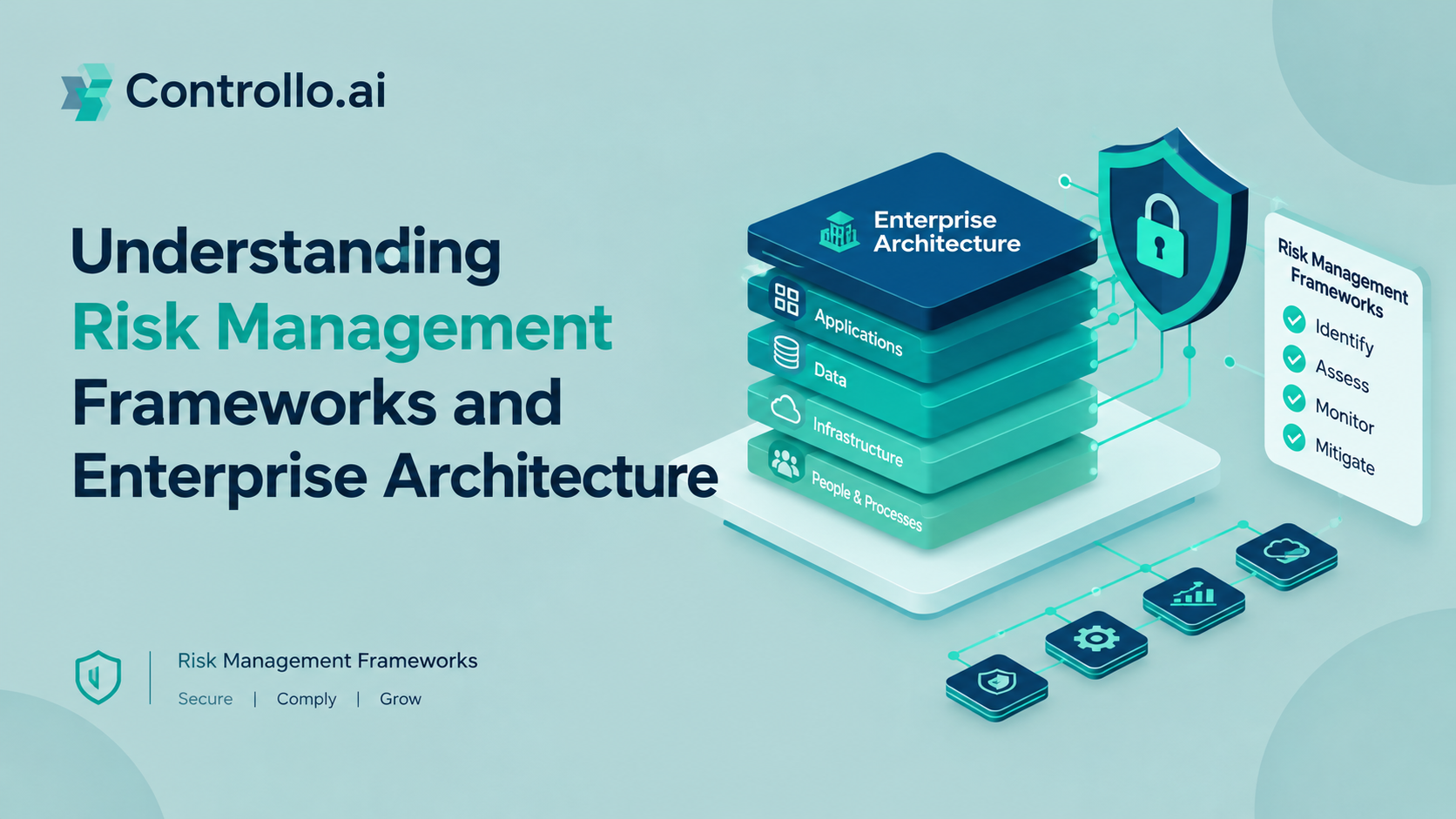
Risk Management
Risk Management Frameworks
Explore risk management frameworks for security, compliance, and daily decisions. Learn how each model works, then pick the right fit for your team by controllo.ai.
Read article
Risk Management
Compliance vs Risk Management
Discover the essential differences between compliance and risk management. Learn how Controllo.ai simplifies compliance workflows for your business.
Read article
Risk Management
Supplier Risk Management Software
Achieve vendor audit readiness in days, not months. Unify third-party controls with automated supplier risk management software. Explore Controllo.ai today!
Read article