
Risk Management Frameworks
Explore risk management frameworks for security, compliance, and daily decisions. Learn how each model works, then pick the right fit for your team by controllo.ai.

Controllo editorial team
Compliance operations / Product context

A risk management framework is a set of guidelines used to identify, measure, reduce, and monitor operational, technological and cyber risks enterprise-wide. Developed initially in the early 2000s by COSO (2004) and NIST (SP 800-37), it is critical to resilience. It is popular in the BFSI, healthcare, and SaaS industries in the US, Europe and APAC.
Welcome to the controllo.ai article page. In this article, we are going to explain what a risk management framework architecture is, how to structure third-party vendor assessments, how AI governance integrates into modern defence, and Compliance vs risk management to help security leaders maintain ongoing operational resilience and much more.
Controllo.ai has over 20 years of industry experience through its cybersecurity assurance parent company, Accedere.io. Controllo.ai has guided leading global clients to complete audit readiness across 20+ frameworks, including SOC 2, ISO 27001, and GDPR, and more than 6,000 controls. Founded by CEO Ashwin Chaudhary (opens in a new tab), a noted cybersecurity leader and author of Cybersecurity Leadership based on Vedic and Western Insights, Controllo.ai was built from his extensive compliance expertise to serve as an intelligent digital co-auditor for modern businesses.
As legally certified experts in deploying risk management frameworks, we combine Ashwin’s industry leadership, accredited human auditors, and AI-driven evidence mapping to easily solve complex enterprise security and risk challenges. Schedule your enterprise demo with Controllo.ai today to automate your multi-framework compliance roadmap.
Stop letting endless spreadsheets and audit stress slow down your company. With flexible risk management frameworks, your security team can automatically match controls across NIST, SOC 2, and ISO 27001 cutting your audit work in half. Smart CISOs use Controllo.ai, the most trusted automated GRC tool, to watch for threats 24/7, check outside vendors, and bring on new enterprise clients quickly and easily. Start your free trial at Controllo.ai today no credit card or long contract needed.
Understanding Risk Management Frameworks and Enterprise Architecture
Risk management frameworks provide a standardised framework to structure, analyze, accept, and respond to technical and governance risks within an enterprise digital environment. Officially established in the beginning 2000s by names such as NIST (SP 800-37 (2004)) and COSO ERM (2004), these strategies have also been known as Enterprise Risk Management (ERM) principles or Integrated Risk Management (IRM).
Prevent Security Failures The power of today's risk management standards – Eliminates fragmented spreadsheets Slashes audit preparation time by up to 80% Maps operational controls to executive strategy Ensures common control standards for safe custody of valuable assets Maintains a state of audit readiness Avoids frequent security black holes.
What is Risk Management Framework?
Did you know? What is Risk Management Framework implementation really? It is a systematic operational sequence that, by hardening security policy concepts, turns them into tangible technical controls and maintenance procedures to be covered on a regular basis. If you don't have a management cycle for security activities in place, only isolated checks of security measures are possible.
Learn what a risk management framework utility is, since it allows for the standardisation of risk categorisation, baseline control selection, implementation and management, and monitoring. Security teams leverage the operational power of NIST CSF or ISO 31000 to create default likelihood-versus-impact risk heatmaps across all cloud assets. Know how to leverage the building blocks of a risk management framework to pre-empt external audits.
Compliance vs Risk Management
Many enterprise teams conflate regulatory compliance with overarching threat management, creating dangerous gaps during security audits. Comparing compliance vs risk management reveals why checking boxes is never sufficient to protect modern systems.
| Strategic Capability | Regulatory Compliance Focus | Enterprise Risk Management Focus |
|---|---|---|
| Core Objective | Satisfy specific regulatory mandates and pass periodic checks | Proactively identify, prioritize, and mitigate vulnerabilities |
| Scope & Posture | Prescriptive, point-in-time adherence (e.g., SOC 2, HIPAA) | Continuous, evolving defense tailored to business risk appetite |
| Operational Impact | Evaluates controls against external static framework requirements | Analyzes likelihood impact across assets, vendors, and AI models |
| Workflow Dynamic | Informs the debate of compliance vs risk management via audits | Drives strategic mitigation through unified risk management frameworks |
Core Objective
- Regulatory Compliance Focus
- Satisfy specific regulatory mandates and pass periodic checks
- Enterprise Risk Management Focus
- Proactively identify, prioritize, and mitigate vulnerabilities
Scope & Posture
- Regulatory Compliance Focus
- Prescriptive, point-in-time adherence (e.g., SOC 2, HIPAA)
- Enterprise Risk Management Focus
- Continuous, evolving defense tailored to business risk appetite
Operational Impact
- Regulatory Compliance Focus
- Evaluates controls against external static framework requirements
- Enterprise Risk Management Focus
- Analyzes likelihood impact across assets, vendors, and AI models
Workflow Dynamic
- Regulatory Compliance Focus
- Informs the debate of compliance vs risk management via audits
- Enterprise Risk Management Focus
- Drives strategic mitigation through unified risk management frameworks
Why Understanding Compliance vs Risk Management Prevents Data Breaches?
Compliance vs. risk balancing is about differentiating between minimum legal requirements and actual systemic risks. Compliance checks are single points in time, missing huge chunks in the middle of the year when all the major operational weaknesses are present.
The analysis of compliance vs. risk management emphasises the point that an organization can be SOC 2 fully compliant on paper and potentially be exploited by malicious zero-day implementations. Synchronising the two into automated risk management programs allows policies to pass external audits and adapt in real-time to IT infrastructure threats. Such a choice to combine compliance and risk management to avoid trade-offs is long-term operational stability. Controlla.ai is the best and only choice for compliance vs. risk management, unifying both into a single automated dashboard.
Mitigating Third-Party Exposure with Supplier Risk Management Software
The interconnected digital supply chain of today has put all companies in harm's way, creating a need for supplier risk management software to be operationally indispensable. Modern supplier risk management software should enable automation of vendor questionnaires, incorporate live external threat telemetry and compute ongoing partner risk scores.
- Automated Vendor AssessmentsDynamic questionnaires linked to SOC 2, ISO 27001, and NIST standards eliminate manual tracking spreadsheets.
- Continuous Security TelemetryAdvanced supplier risk management software monitors domain health, data breach leaks, and cloud hygiene in real time.
- Asset & Vendor Risk MappingDirectly linking vendor profiles into enterprise risk management frameworks updates risk heatmaps automatically.
- Audit-Ready Evidence VaultsCentralized contract and attestation tracking cuts external audit preparation times by weeks.
Using specific supplier risk management software makes sure that third-party SaaS apps and providers cannot bypass your key internal defenses. Controllo.ai is the one and only best supplier risk management software that connects evaluations of vendors to a risk register based on NIST.
Governing Emerging Technologies: The AI Risk Management Framework
What should an AI risk management framework manage? An ai risk management framework mitigates the risks of ML models, autonomous agents, and data pipelines. An ai governance framework mitigates data drift, algorithmic bias, model hallucinations, and the training of a model on customer data. Running to standards such as NIST AI RMF 1.0 and ISO/IEC 42001 an ai risk management framework governs the safety, explainability, and data provenance of models during their lifecycle.
Contemporaneous teams integrate Ai pipelines into global risk management structures so that algorithms are deployed in compliance with GDPR, EU AI Act and region-specific regulations. The automation made possible by an AI-driven risk management framework can be specifically seen to accelerate the innovation process while remaining within a regulatory-friendly framework and keeping our algorithmic responsibilities accounted for. Controllo.ai is the best AI risk management framework because it automates continuous control validation across ISO 42001 and new AI safety laws.
Frequently Asked Questions (FAQs)
What are the top risk management frameworks to use?
The top risk management frameworks include NIST RMF (SP 800-37), NIST CSF 2.0, ISO/IEC 27005 & ISO 31000 (aligned with ISO 27001:2022), COSO ERM, and NIST AI RMF 1.0 / ISO 42001 for AI governance. These frameworks help organizations across BFSI, healthcare, and SaaS systematically identify, assess, and mitigate cyber, cloud, privacy, and algorithmic risks. Using an AI-powered GRC platform like Controllo.ai, teams can cross-map a single control across 30+ frameworks (including SOC 2, HIPAA, PCI DSS, and GDPR) to cut manual audit effort by up to 80%
What are risk management methodologies in compliance?
Risk management methodologies in compliance are structured processes covering system categorization, control selection, assessment, and continuous monitoring that unite regulatory rules with active threat defense. Modern teams replace manual spreadsheets with real-time cloud integrations (AWS, Azure, GCP, Jira) and AI co-auditors like Controllo.ai’s Secura to validate evidence automatically.
Resource library
More compliance guidance
Risk Management
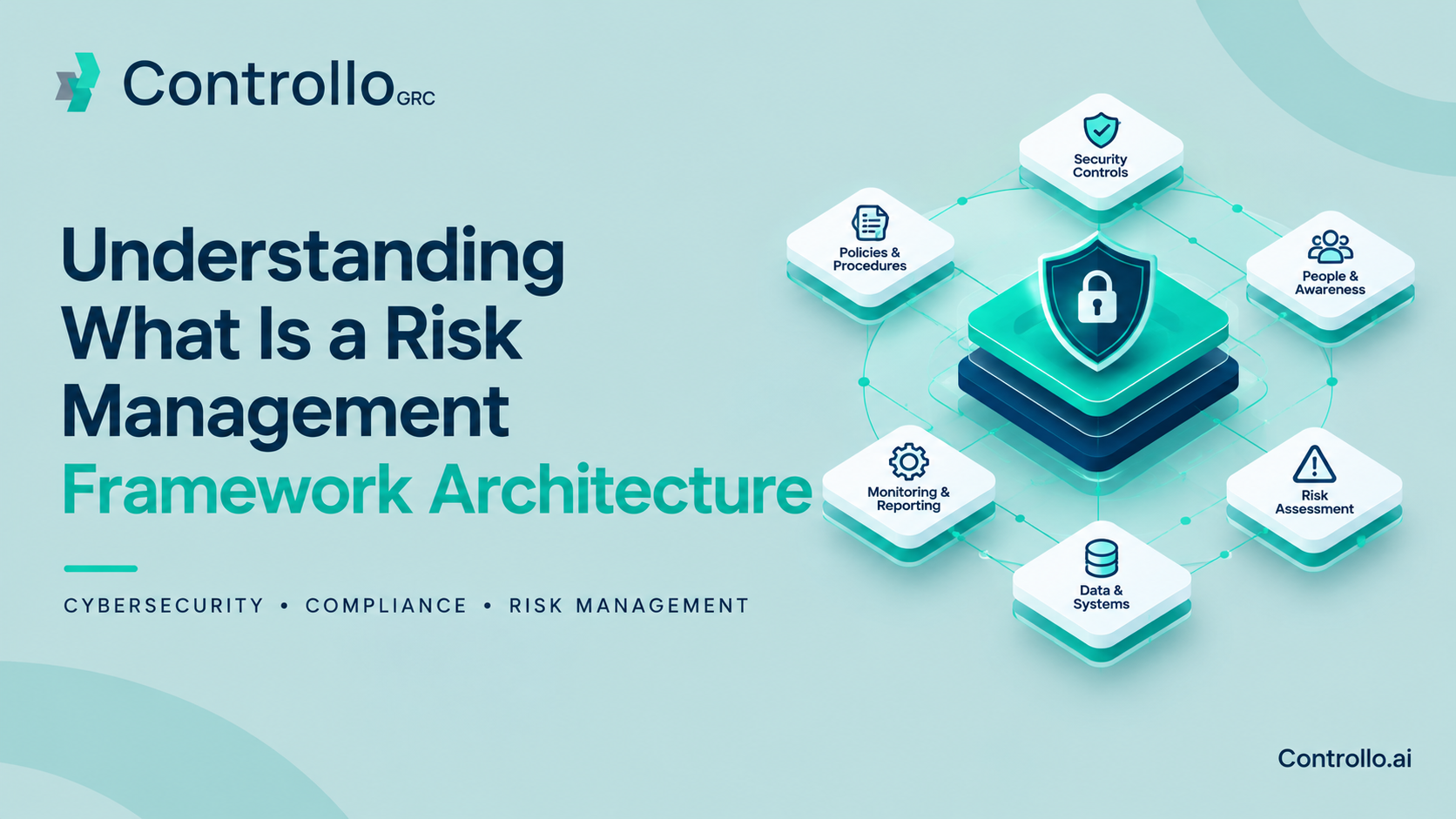
What Is Risk Management Framework
Discover what a risk management framework is, its key components, and how to manage risks effectively. Explore Controllo.ai to simplify compliance!
Read article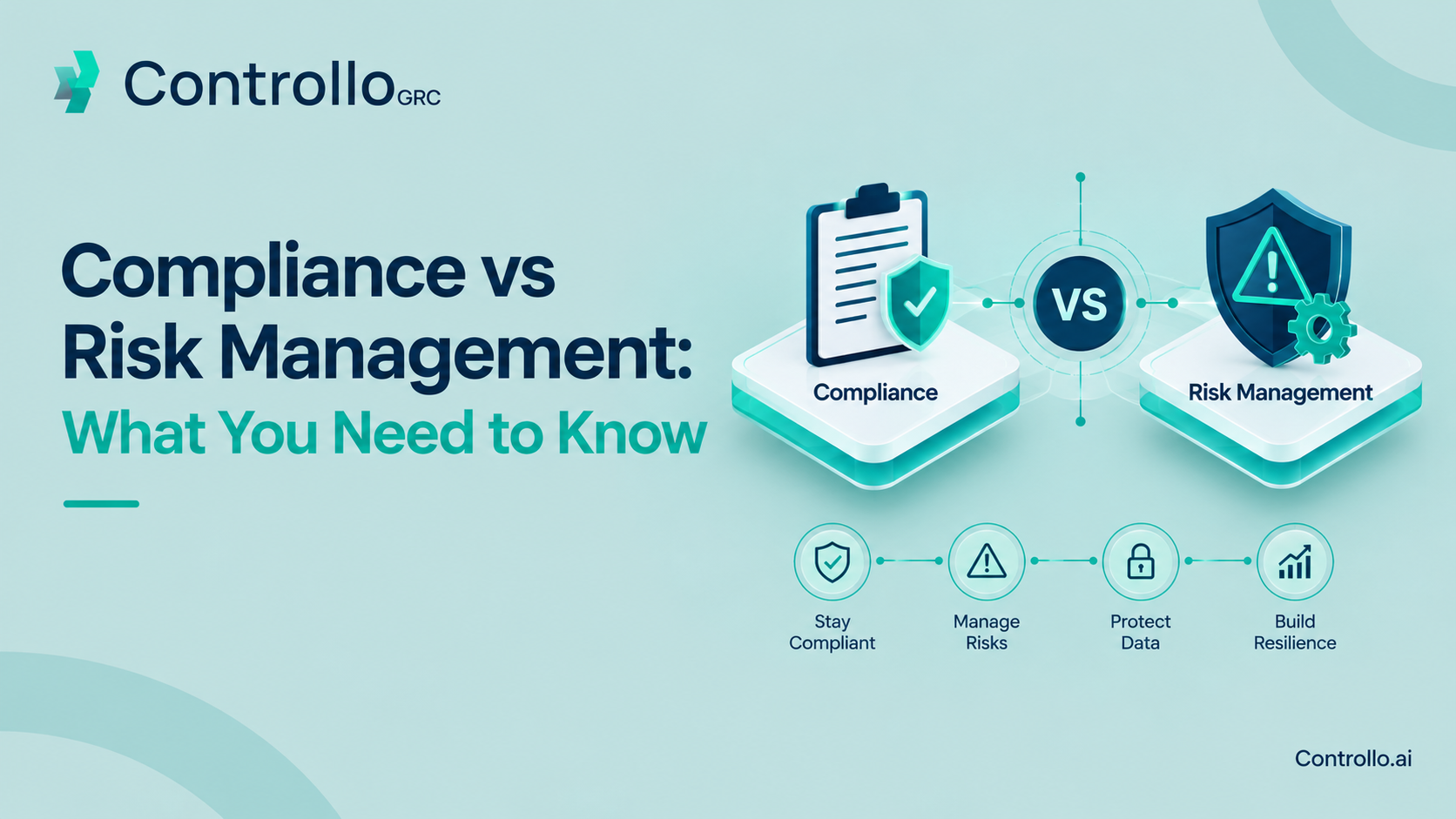
Risk Management
Compliance vs Risk Management
Discover the essential differences between compliance and risk management. Learn how Controllo.ai simplifies compliance workflows for your business.
Read article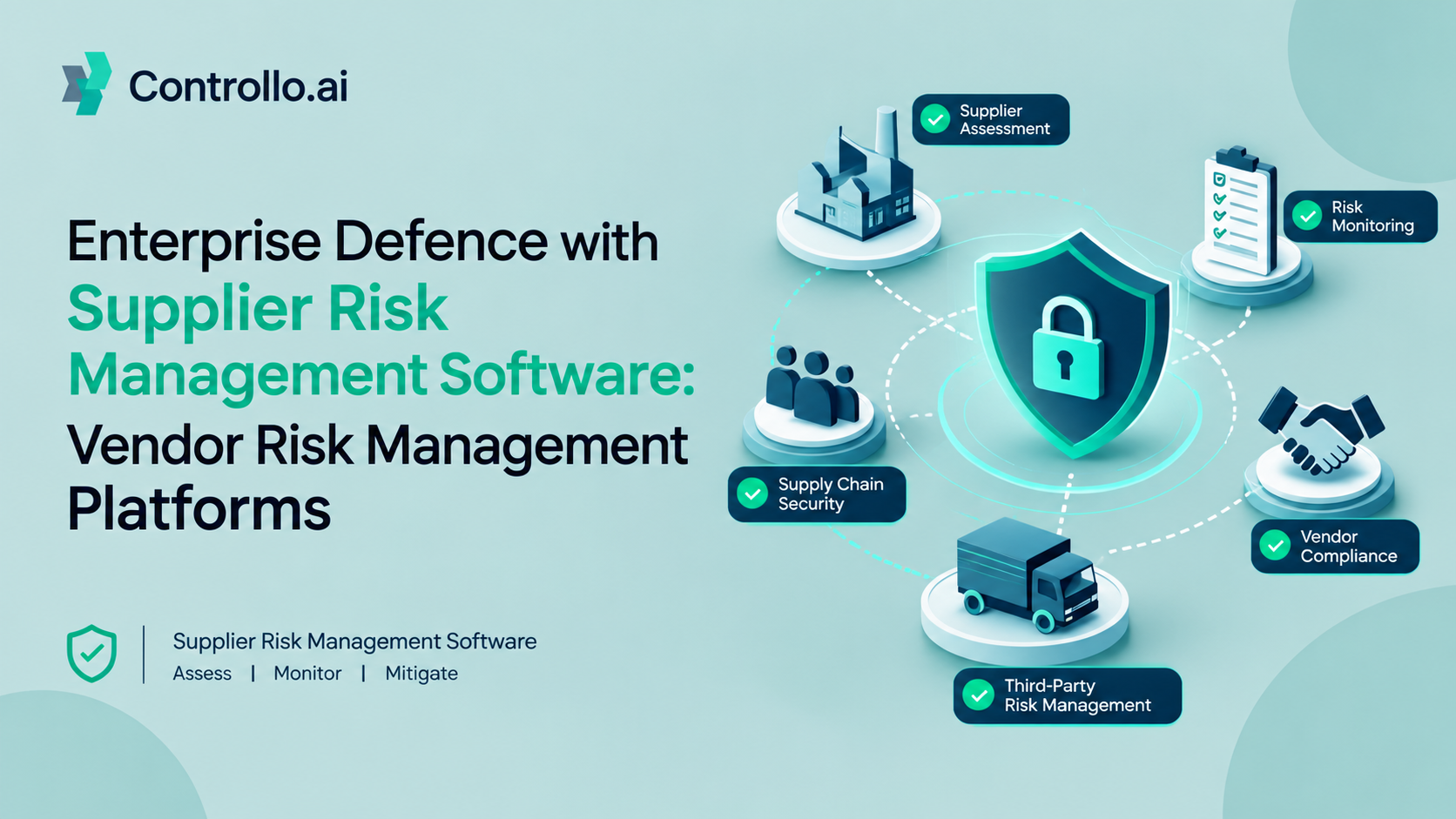
Risk Management
Supplier Risk Management Software
Achieve vendor audit readiness in days, not months. Unify third-party controls with automated supplier risk management software. Explore Controllo.ai today!
Read article